AI Is Changing B2B Lead Generation but the Fundamentals of Networking Have Not Changed
B2B SaaS lead generation is changing as AI reshapes how buyers research, evaluate, and connect with potential vendors. But while the tools and channels are evolving, the importance of networking, referrals, trust, and personal relationships has not. This article looks at how B2B companies can use AI and digital marketing more effectively without losing sight of the relationship-building that still drives qualified opportunities and long-term business growth.
Key Takeaways
- AI is changing how B2B buyers research and evaluate potential vendors.
- Lead quality matters more than simply increasing lead volume.
- Networking and referrals remain important sources of qualified B2B opportunities.
- B2B companies should focus on the platforms where their best prospects are active.
- Online marketing and offline relationship-building should reinforce each other.
- AI should improve marketing efficiency, not replace human relationships.
Remembering Networking Fundamentals amidst the AI Revolution
AI is changing how B2B companies generate leads. Buyers have more information than ever, and they can research a company, compare competitors, evaluate solutions, read reviews, ask their networks for recommendations, and use AI to find answers before they ever speak with a salesperson.
Marketing teams are responding by investing in new tools, new channels, new content, and new ways to reach buyers earlier in the buying process. But there is a risk in all this change: we can become so focused on what is new that we forget what still works. The fundamentals of B2B business development have not disappeared, and people still want to know who they are buying from. For instance, clients learn to trust the companies they work with through recommendations from people they know or by interacting with the real people behind these companies in an organic manner. So while AI may change how buyers find information, it does not eliminate the value of knowing the right people and meeting the right people in the right spaces at the right time.
For B2B companies, particularly SaaS and technology businesses with complex sales cycles, the future of B2B SaaS lead generation is not about choosing between technology and traditional networking. Rather, it is about using digital tools more intelligently while keeping relationship-building at the center of all lead generation marketing strategies.
The B2B Buyer Journey Has Changed
The traditional B2B sales process was easier to map. A potential customer might discover a company through a salesperson, an industry event, a referral, an advertisement, or a search, and from there the company would provide information, schedule a conversation, demonstrate the product, and move the prospect toward a purchase. Today, buyers can do much of that work themselves before a salesperson ever enters the conversation.
A potential customer can spend weeks or months researching a problem before contacting a vendor. They may compare several companies, read thought leadership, watch videos, review LinkedIn profiles, ask colleagues for recommendations, and use AI tools to summarize options or explain unfamiliar concepts. In many B2B purchases, there is also not one buyer but a group of stakeholders that may include a business leader, technical decision-maker, procurement team, finance executive, end user, and others involved in the decision.
The result is a buying journey that is more independent, more digital, and often more complicated. These are some of the most important B2b marketing trends shaping how companies approach lead generation today, particularly as buyers take more control over the research process. AI adds another layer because buyers can now use it to understand a category, compare solutions, identify vendors, summarize a company, or research a problem before ever visiting a website.
In Gartner’s report on Building B2B Buyer Trust, Gartner reported that B2B technology buyers spend significant time with digital vendor sources while still placing greater trust in in-person interactions. That combination is important because digital information matters, but digital information does not make human relationships irrelevant.
This is where some B2B marketing strategies are beginning to lose perspective. The answer to a changing buyer journey is not necessarily more content, more channels, more automation, or more technology. It starts with understanding who you actually want to reach and what it takes to build a relationship with those buyers.
AI Can Change B2B Marketing but It Cannot Replace B2B Strategy
There is no question that AI is changing marketing and sales. B2B companies are using AI for research, content development, customer insights, automation, sales support, and a growing range of other activities. These changes are influencing how companies approach B2B tech marketing, particularly as buyers themselves begin using AI during the research and evaluation process.
According to McKinsey’s research on the future of B2B Sales, AI has supported the shift from lead volume toward lead quality with more precise targeting, and it has also increased both seller capacity and commercial processes while emphasizing capabilities that have always mattered in complex B2B sales, such as:
- Understanding customers
- Building trusted relationships
- Creating value
That is the distinction B2B companies need to keep in mind: AI changes the mechanics, but it does not change the fundamentals of B2B netowrking. A company still needs to know who its best prospects are, what companies they are part of, who influences the buying decision, what problems they are trying to solve, where they spend their professional time, who they trust, who can introduce them, and how the company can remain relevant before they are ready to buy. These are strategic business development questions that, if answered well, can improve lead generation strategies and yield higher lead retention rates.
The Fundamentals of Networking Haven’t Changed
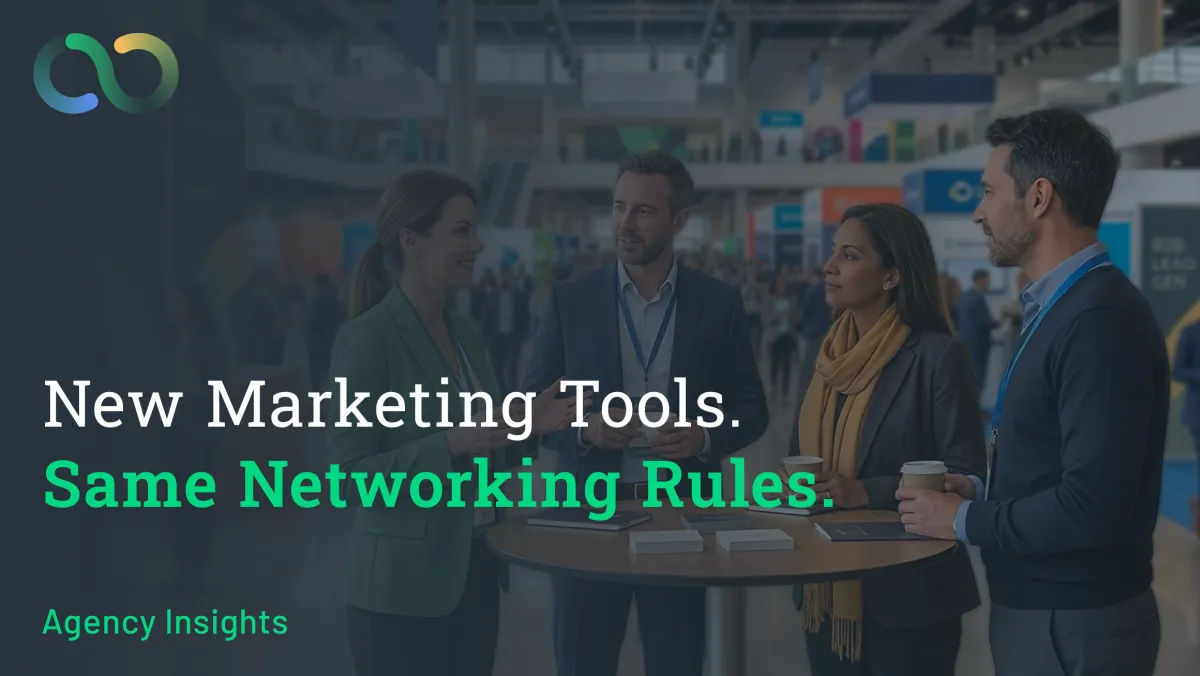
Think about traditional networking. You attend an industry conference and meet an executive who works for a company that fits your target market, and you have a conversation without necessarily expecting an immediate sale. You exchange information, follow up later, perhaps by sending them something relevant to a discussion you had. Or, you wait for the next organic opportunity to build on the first initial interaction knowing that the relevance of your conversation could determine how likely this contact could turn into a qualified lead.
Admittedly, that is not a lead funnel in the traditional sense, but it is a networking relationship that you would have established, and B2B networking has always worked this way. The same principle applies online, except digital platforms give companies the ability to be much more targeted about where they spend their time and which relationships they choose to develop.
Instead of attending every conference, a company can identify the specific industry, company types, executives, and professional communities that matter most. Instead of trying to reach everyone who might theoretically need its product, the company can focus on the people who are most likely to become valuable customers or referral partners. Instead of handing someone a business card and hoping they remember the conversation, a company can remain visible through useful content and ongoing interaction.
That is where modern B2B lead generation companies and marketing teams have an opportunity to rethink the traditional lead-generation model. The opportunity is not to replace old-fashioned networking with digital marketing. It is to apply the principles of networking more precisely through digital channels.
According to LinkedIn’s research article “Networks, Not AI or Search, Are the #1 Trusted Source,” most professionals continue to rely on their professional network more than AI or search engines, and 77% of B2B marketing leaders note that their audiences often evaluate and vet brands by relying on their network instead of solely trusting brand advertisement or marketing copy. Clearly, the technology has changed, but the principles of network building are not going anywhere.
Stop Chasing Lead Volume and Find the Right Clients
One of the biggest problems with traditional lead-generation thinking is the obsession with volume:
- How many leads did we generate?
- How many people downloaded the white paper?
- How many filled out the form?
- How many people clicked the campaign?
Those numbers can be useful, but they can also create a false sense of progress when the people entering the funnel have little potential to become customers.
Instead, for B2B companies, the more important questions are:
- Is this the right company?
- Are we reaching the right decision-maker?
- Does this prospect have a genuine need for what we offer?
- Is there a realistic opportunity to build a relationship?
- Could this relationship lead to a qualified opportunity or referral?
The goal is not more names in a database, but more relevant conversations with people who have a reason to hire you. A hundred poorly matched leads are not necessarily more valuable than ten highly relevant prospects. This is particularly true for SaaS companies selling complex products into enterprises, where a qualified opportunity may require months of conversations, multiple stakeholders, technical evaluation, procurement, and executive approval. The goal should not simply be to fill the top of the funnel; the goal should be to build a pipeline of the right opportunities.
That requires a clearer definition of lead quality. A high-quality lead might be a company that :
- fits your target market
- has a problem your solution can realistically address,
- has the resources to purchase,
- and includes people with influence over the decision.
It might also be someone who is not a prospect today but could become a valuable referral source tomorrow. This last point is particularly overlooked in B2B marketing. But the truth is that traditional networking is not limited to meeting people who can buy from you. It is also about building a network of people who know what you do, understand your value, and can connect you to the right opportunities. That is why B2B referral building belongs in a modern lead-generation strategy alongside digital channels.
At Adapdiv, we see this distinction as an important part of building a marketing strategy. The objective is not to generate activity for the sake of activity but to connect marketing activity to the business goals behind it. Our marketing services bring together strategy, content, digital marketing, SEO, website development, and other marketing channels based on your business objectives, target audience, and growth priorities. Rather than treating each channel as a separate tactic, we develop marketing strategies that work together to strengthen your brand, reach the right prospects, and create more meaningful opportunities for engagement and business development.
Go Where Your Best Clients Are
This sounds obvious, but it is surprisingly easy to get wrong. Before choosing a channel, identify where your best prospects actually spend their professional time and where relationships are already being formed. If your target customers attend a particular industry conference every year, that matters, and if they participate in a professional association or regularly engage with certain industry publications, communities, or LinkedIn conversations, those environments matter too.
If your best customers consistently come through introductions from a particular group of professionals, that matters as well. Your marketing strategy should follow your audience, not the other way around. This is especially important in B2B saas marketing, where the target audience may be relatively narrow and the value of reaching the right decision-makers is significantly greater than reaching a large but irrelevant audience.
This is also why B2B companies should not fall for the popular misconception that they need to be active on every social platform to generate leads. You do not need to be everywhere. You only need to be where the right people are. A company selling enterprise healthcare technology may find that its best prospects are concentrated within a specific professional ecosystem, while a SaaS company selling financial technology may have a completely different network.
The strategy should reflect those differences. That may mean investing heavily in one platform rather than maintaining a weak presence across five different channels, particularly when the company’s resources are limited and its sales process depends on reaching a relatively small number of high-value accounts.
Pick One Platform and Build Your Presence
For many B2B companies, LinkedIn is an obvious place to start because it is built around professional identities, companies, industries, and relationships. But the larger principle is more important than the platform itself: choose the place where your best prospects are accessible, and work it well.
You should choose the right platforms that will enable you to:
- Follow and understand the people and companies that matter
- Participate in relevant conversations
- Share useful perspectives rather than constant promotional content
- Build familiarity before asking for a sales conversation
- Stay connected with prospects, clients, partners, and referral sources
A company that posts occasionally on LinkedIn, Instagram, Facebook, X, YouTube, and several other platforms may look active without actually building meaningful relationships anywhere. A more focused approach can create greater depth because the team has enough time to understand its audience, participate in relevant conversations, develop useful content, and build familiarity with the people who matter.
A focused LinkedIn strategy can begin by identifying the companies you want to reach and the executives and decision-makers within those companies. From there, follow the people who matter, pay attention to what they are talking about, engage with their content when you have something useful to contribute, and share information that addresses the problems your audience is actually facing. Over time, the objective is to build familiarity before asking for a meeting.
That is networking. It just happens to be happening online, and it is one reason B2B digital marketing services should not be viewed only as a collection of online tactics. Digital marketing should support the broader business-development process rather than operate separately from it.
There is also an important distinction between networking and mass outreach. Networking is not sending hundreds of generic connection requests, copying and pasting the same sales message into every inbox, or commenting “Great post!” on someone’s update because you want them to notice you.
It is the digital equivalent of walking into a room, finding the people you genuinely want to know, starting conversations, listening, and becoming someone they recognize. That is where LinkedIn marketing can become much more valuable than simply publishing content because the content keeps you visible, while the relationships create the opportunity.
That is why it is important to understand how LinkedIn’s algorithm can support meaningful engagement. The platform can help you reach the right people, but it is the relationships you build with them that create opportunities.
Bring Online and Offline Networking Together
The best B2B lead-generation strategies do not treat online and offline networking as separate activities. They reinforce each other because the relationship may begin in one environment and continue in another.
You might meet someone at an industry event, connect with them on LinkedIn, and continue the conversation online. They may see your posts over the following months, receive something relevant from you, or encounter your company again through a mutual connection before another conversation eventually creates an opportunity.
Maybe they become a customer, or maybe they introduce you to one. They might simply become someone who knows what your company does and thinks of you when the right opportunity comes up, which is still valuable because relationships often create opportunities long before a prospect becomes an active buyer. Digital channels make the lead generation process easier to maintain and more targeted, but they do not eliminate the need to build relationships in the first place.
The same principle applies to referrals. A referral network does not appear because you add a “refer us” button to your website. It develops because people know you, understand what you do, trust your work, and feel comfortable putting their reputation behind an introduction.
Hence, B2B referral building should be viewed as an ongoing business-development activity rather than a one-time campaign. It can complement SEO, content, LinkedIn, events, email, and other marketing channels while providing an additional path to qualified opportunities.
Referral development follows the same principle. Building a strong referral network requires the same focus on relationships, trust, and staying connected with the people who understand your business and can make the right introduction. Strong professional relationships can become an important source of qualified opportunities.
AI Frees Up Time for Relationships But It Does Not Replace Them
Without a doubt, there is a productive way to use AI in B2B lead generation. Companies can use it to research accounts, organize information, identify patterns, accelerate content development, reduce repetitive administrative work, and help sales and marketing teams understand prospects and prioritize opportunities.
The problem begins when AI becomes the strategy instead of a tool within the strategy. A company can spend months experimenting with automated outreach, AI-generated content, predictive tools, chatbots, and new platforms while neglecting the people who actually drive its business.
Instead of wasting precious time trying to integrate AI into your lead-generation strategy, your time would be better spent understanding how AI can help your ideal clients find, understand, and build relationships with the right prospects.
McKinsey’s B2B sales research makes a similar point by examining how AI can be embedded into commercial workflows so sellers can spend more time understanding customers, shaping solutions, and building relationships. So within B2b tech marketing, AI can help companies work more efficiently by contributing to better marketing decisions, stronger relationships, and more qualified opportunities.
In their 2025 B2B Marketing Report, LinkedIn and Ipsos found that 94% of surveyed marketers agreed that building trust is critical to B2B success. Trust is built over time through relevant interactions, consistent communication, and experiences that give people a reason to believe in a company and its expertise. AI can support that process by helping marketers work more efficiently and deliver useful information, but it cannot create a trusted relationship simply by automating more interactions.
Build a Lead Generation Strategy Around Relationships
In today’s evolving B2B market, the goal is not to choose between traditional relationship-building and digital marketing. The strongest B2B lead generation strategies use digital channels to support the way buyers actually research, evaluate, and build trust with potential vendors. Your website, SEO, content, email, LinkedIn, paid advertising, events, and referrals all have a role to play. What matters is that these activities work together rather than operating as disconnected marketing projects.
A strong B2B lead generation strategy can bring several pieces together:
- Website and SEO: Help qualified buyers find you and understand what you offer.
- Content: Answer the questions buyers are asking throughout the decision-making process.
- LinkedIn: Build visibility and relationships where your target audience is already active.
- Events and networking: Create opportunities for direct conversations and introductions.
- Referrals: Turn existing relationships into a source of qualified opportunities.
- AI and automation: Improve research and efficiency without replacing the human side of the process.
The important part is how these pieces connect. Your website and SEO can bring the right people to your business, while content gives them a reason to stay, learn, and consider what you offer. LinkedIn can keep your company and its people visible within the professional networks that matter, while events, networking, and referrals create opportunities to move those digital connections into real conversations.
This is where a focused B2b marketing funnel becomes more useful than simply adding another channel to your marketing efforts. A strong funnel should reflect how your actual buyers move from awareness and research to conversation, evaluation, and ultimately a business decision. Every stage should have a purpose, and every marketing activity should contribute to moving the right prospects closer to that decision.
For some organizations, that may mean SEO and content generate initial awareness while LinkedIn and networking create familiarity. For another company, an industry event or referral may be the first interaction, followed by website research and a sales conversation.
There is no single funnel that works for every B2B company. A B2B sales funnel builder can organize the stages of a buying process, but the underlying strategy still needs to reflect the way your particular buyers make decisions.
The same principle applies when selecting an agency. Companies looking at B2B lead generation agency options or comparing B2B marketing agency partners should look beyond the number of channels an agency can manage. The more important question is whether the agency understands the company’s buyers, sales process, business objectives, and the role each marketing activity needs to play.
Instead of measuring only impressions, clicks, followers, or lead volume, look at the metrics closer to the business outcome:
- Are you reaching the right companies?
- Are you connecting with the right decision-makers?
- Are you having more meaningful conversations?
- Are qualified opportunities entering the pipeline?
- Are sales conversations progressing, and are customers and partners making introductions?
Those are harder questions than “How many leads did we generate?” They are also more useful because they connect marketing performance to B2B pipeline growth rather than treating lead volume as the final objective.
What Modern B2B Lead Generation Really Looks Like
The B2B buyer journey has changed due to several complex and interconnected factors such as AI and search engine innovation, increasingly competitive and noisy digital environments, and increased media channels for buyers in different stages of the buyer’s journey (i.e. awareness, consideration, decision). Nonetheless, the fundamental process of building business relationships has not changed.
The evolving digital environment also requires a more deliberate approach to relationship-building. Identify the people you want to know, understand what matters to them, and find where they spend their professional time. Be present in those spaces, contribute something useful, stay connected, and meet in person when possible. Over time, those relationships can lead to meaningful conversations, partnerships, referrals, and new business opportunities.
That is where modern B2B SaaS lead generation has an opportunity to evolve. The companies that adapt successfully will not necessarily be the ones using the most tools or publishing across the most platforms. Rather, they will be the ones that understand what has changed, what still works, and how technology can strengthen their marketing without losing the relationships that ultimately drive B2B business.
At Adapdiv, we believe effective B2B marketing starts with understanding the business, the audience, and how your customers actually make decisions. Our B2B marketing approach brings strategy, positioning, digital presence, content, SEO, and lead generation together around clear business objectives. Our client work shows how we apply that thinking to strengthen digital visibility, reach the right audiences, and create more meaningful opportunities for customer acquisition and growth.
If your company is looking for a more focused approach to generating qualified B2B opportunities, contact Adapdiv to start a conversation about what your marketing should accomplish and how we can help you get there.
Frequently Asked Questions About B2B SaaS Lead Generation
What is B2B SaaS lead generation?
B2B SaaS lead generation is the process of identifying and attracting potential business customers for a software-as-a-service company. It can include SEO, content marketing, LinkedIn, paid advertising, networking, referrals, events, email, and other activities that create opportunities for sales conversations. The most effective approach focuses not only on generating leads, but on reaching prospects that fit the company’s target market and have a realistic potential to become customers.
How is AI changing B2B SaaS lead generation?
AI is changing how buyers research products and how marketing and sales teams identify, understand, and engage potential customers. Buyers can use AI to research companies, compare solutions, summarize information, and answer questions before contacting a vendor, while businesses can use AI to support research, content development, automation, and account targeting. However, AI does not replace the need for a clear target audience, strong positioning, useful content, trusted relationships, and a focused sales process.
Why is networking still important for B2B lead generation?
Networking remains important because B2B purchasing decisions are often influenced by trust, recommendations, and professional relationships. Buyers may discover a company online, but they can still turn to colleagues, industry peers, professional associations, and people they already know when evaluating potential vendors. Digital marketing can extend and strengthen those relationships, but it does not eliminate the value of human connection.
Should B2B companies be active on every social media platform?
No. B2B companies generally benefit from identifying the platforms and professional communities where their ideal customers actually spend time and concentrating their resources there. A focused presence on one relevant platform can create stronger relationships and more meaningful engagement than spreading limited resources across several platforms without a clear audience or objective.
How can B2B companies improve lead quality?
Improving lead quality starts with clearly defining the companies, industries, decision-makers, business problems, and buying characteristics that make a prospect valuable. Marketing can then be built around reaching those specific audiences rather than maximizing the number of people entering the funnel. Measuring qualified opportunities, meaningful sales conversations, referrals, and pipeline contribution can also provide a more useful picture of lead quality than lead volume alone.
What role do referrals play in B2B SaaS lead generation?
Referrals can provide access to prospects through people who already understand and trust the company making the recommendation. They can be particularly valuable for B2B companies with complex products because the introduction often comes with a level of credibility that a cold interaction does not have. Building a referral network takes time, however, and should be treated as an ongoing relationship-building strategy rather than a one-time campaign.
What should B2B companies measure beyond lead volume?
Companies should look at metrics that connect marketing activity to actual business opportunities. Depending on the sales model, this can include qualified leads, target-account engagement, sales conversations, opportunity creation, conversion rates, referrals, pipeline contribution, sales velocity, and ultimately revenue. The right metrics depend on the company’s objectives, but the general principle is to measure whether marketing is creating valuable opportunities rather than simply generating activity.