The way we make things is changing. Factories are no longer just about scale and efficiency—they’re about agility, personalization, and blending human creativity with AI-driven power. At Adaptiv, we believe the future of production isn’t about machines replacing people, but about AI and humans working together to deliver faster, cheaper, and smarter results.
Speed and Cost: Where AI Shines
AI is reshaping production by doing the heavy lifting behind the scenes:
Design in Minutes, Not Months
Generative AI can produce dozens of design options in the time it used to take to sketch one. Car makers, for example, are already using AI to generate lightweight, test-ready chassis designs that shave weeks off development cycles.
Factories That Think for Themselves
Agent-based AI systems now monitor and adjust production lines in real time. Instead of waiting for something to break, AI predicts issues before they happen, saving money and downtime.
Robots That Work With, Not Against, People
Cobots (collaborative robots) handle repetitive or risky tasks while human workers focus on creativity, quality, and problem-solving.
The result? Faster cycles, lower costs, and a foundation for scalable growth.
Personalization at Scale
Traditionally, mass production meant uniformity. AI flips that equation.
Customized Products Without Slowing Down
Whether it’s consumer goods or healthcare tech, AI makes it possible to personalize products to individual preferences while maintaining efficiency. Leaders in personalization are already seeing up to a 25% boost in ROI and higher customer engagement rates.
Data Meets Experience
By pairing AI’s analytical power with human judgment, companies can deliver experiences that feel tailored—without sacrificing scale.
Real-World Examples of Smarter Production
This isn’t theory—it’s already happening:
Florasis (Beauty Industry, China)
Their “smart factory” integrates AI for quality checks, defect detection, robotic handling, and real-time monitoring, enabling them to produce 50 million units annually while improving consistency and speed.
Priestley’s Bakery (Australia)
An AI-powered facility now uses autonomous vehicles and cobots to streamline processes. The result: doubled capacity, lower costs, and more time for skilled workers to focus on craft and creativity.
Next-Gen Logistics
Emerging tech like AI-powered magnetic levitation conveyors is cutting energy use and maintenance needs, proving that even the smallest parts of the production line can benefit from smarter systems.
Why Humans Still Matter
Even as AI takes over more of the middle steps of production, the first and last steps still belong to us:
The Beginning: Human creativity, vision, and strategy drive what gets made in the first place. AI can suggest designs, but people define the “why.”
The End: Final touches, quality assurance, and decisions rooted in empathy and context are human strengths that AI can’t fully replicate.
Experts agree that AI won’t replace humans—it will amplify us. Companies that succeed will be those that use AI to free up time and energy for people to do what only people can do: innovate, connect, and lead.
Adaptiv’s Perspective
At Adaptiv, we see a clear path forward:
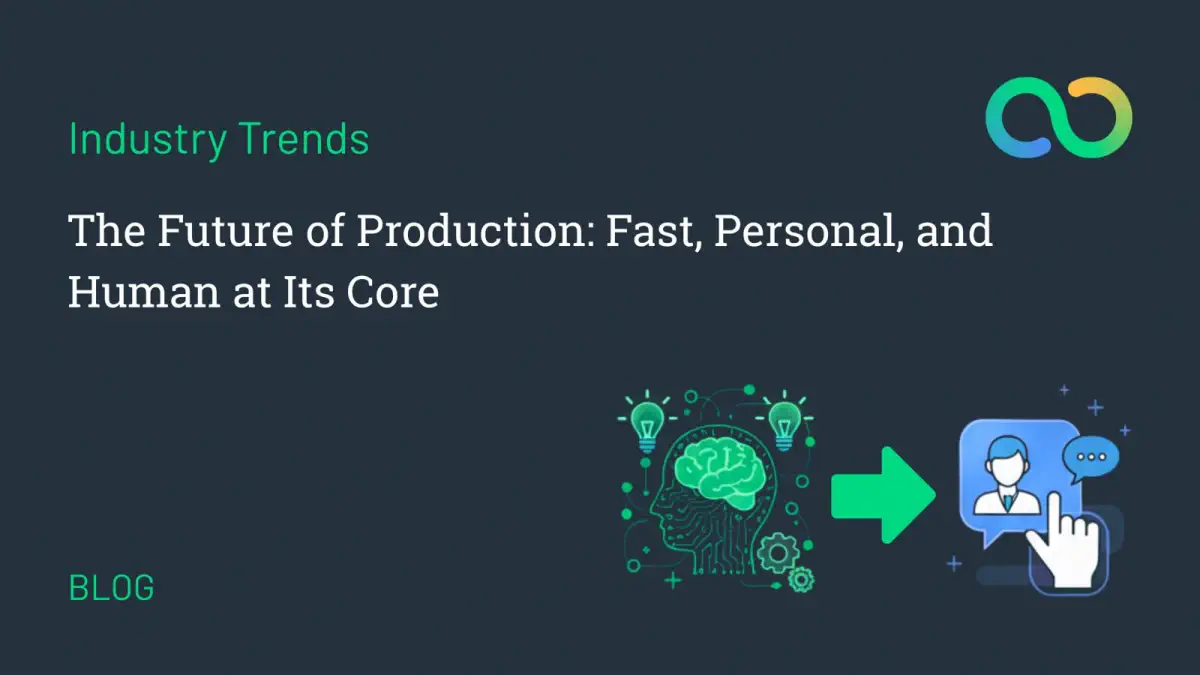
- Human vision starts the process.
- AI makes it faster, cheaper, and scalable.
- Human judgment finishes it—ensuring quality, empathy, and trust.
This hybrid future makes production more than just efficient—it makes it personal, meaningful, and sustainable.
The future of production isn’t about automation replacing tradition. It’s about a smarter partnership: AI streamlining the middle while humans remain the driving force at the start and the finish. When the two merge, businesses unlock speed, cost-efficiency, personalization, and scale—without losing the human essence that makes products worth creating in the first place.
Sources: